Showing posts with label Art. Show all posts

Saturday, July 11, 2026

2.3 Meters

If, as Karl Marx opined, "Religion is the sigh of the oppressed creature, the heart of a heartless world, and the soul of soulless conditions. It is the opium of the people," the idea that the spread of automated systems that can reliably mimic human cognition and interaction will make "genuine human connection" more valuable is the copium (or maybe hopium) of the current day.

In part because I believe that it's not the technology that's at issue here. I remember Twenty Minutes into the Future and (the American version of) Max Headroom, and the conversations I would have with friends about them. While Max was created with practical effects, as the computer technology of the time wasn't sophisticated enough to manage it, we all thought it would be amazingly cool if computers could generate a character like that. While I have nothing against Matt Frewer, we were somewhat disappointed that he played Max via prosthetics, as opposed to character being CGI.

Of course, at the time, there wasn't the idea that the point behind advancing such technology was to advance an apparent class war between the investor class and people who wanted to work for a living. Which is what's in play in the present. But I have my doubts as to the longevity of the sentiment; if for no other reason than people are adept at seeing themselves as exceptional, and thus likely to succeed where other (lesser) people fail. And I think that as the fear of the people behind Large Language Models fades, the opposition to agents and other automated systems on the part of the public at large will fade.

To a degree, it's something of a phantom to begin with. For instance, the TikTok/YouTube series Fruit Love Island took off, racking up millions of views despite being obviously created with extensive use of generative automation. And several people have come forth to claim that they are ai.cinema021/AI Cinema, the anonymous creator behind the videos. Sure, there's been some pushback, but people wouldn't be hoping to pass themselves off as the creator of a property that met with universal opprobrium.

As the tools advance, especially those that are very inexpensive, or even free, to use, there will be more and more media created with it. And while some, or perhaps most, of that will fall into the category of "slop," some non-zero amount of it will be deemed worthy of people's attention. And so technology companies like Meta, Alphabet and TikTok will move to create their own material to create audiences and capture revenue. And since they who control the distribution channel controls the experience, they can privilege their own items over those of other people; presuming that they even need to.

Of course, the technology firms could shoot themselves in the foot by placing significantly more pressure on the job market, and convincing people that the technology needs to go, but even then, that's likely to be more delay than denial. 


Sunday, January 19, 2025

Sculpted

"The Eagle" and the Space Needle
I went down to Seattle Art Museum's Olympic Sculpture Park this morning, with my camera, to take in some of the artworks.
 

Saturday, August 19, 2023

To Go Around

The United States never lacks for teapot tempests. Although I likely shouldn't call them that, or one of the other terms I like to use for them. Because, while they strike me as trivial, at best, for a lot of people, these sorts of disagreements and controversies speak to important factors in their lives.

Consider the reactions to the new Disney production of Snow White. One Rachel Zegler (whom, being old and out of touch with what's hip and with it, I'd never heard of prior to this) has been cast in the title role. Her complexion, given that she's a mix of Eastern European and South American, is decidedly not "snow white." She's also not down with the dynamic of the original animated movie, which is now more than 85 years old. (It hadn't occurred to me before that the original Disney Snow White and the Seven Dwarfs predates the Second World War.) Being one of today's young people (she's named after a character from Friends, after all), she's in favor of a more modern take on the characters and the story.

Cue the outrage. Because there's always "outrage." (It's a pretty low bar to meet these days.)

And while left-leaning media outlets might chalk it up to racism/White supremacy and/or a desire to maintain the "patriarchy," I think that something more is in the mix, and that it may be worth understanding; or at least looking into.

In my own understanding of the world, many Americans are keenly aware of the rejections of others. They feel the sting sharply, and, as a result, are constantly on the lookout for signs that they are being relegated to the bottom of the hierarchy. For people who understand the original Snow White and the Seven Dwarfs as being "for them," as it were, a version of the story that espouses different (and competing) values and is perceived as being a replacement of that story, is also seen as a desire to replace them.

One of the complaints about these sorts of updates is, according to Franchesca Ramsey (by way of NPR): "Why not just make a new story, why did they have to change it?" Now, to be sure, I think that part of the answer to this is: It's faster. Creating characters and stories that will come to be seen as iconic isn't a quick-and-dirty process that can be fired off on command. It's very hit or miss, and can take a long time. Snow White is an old story, with many revisions (and sanitations) over the centuries it's been around. But the question reminded me of The Wiz, the adaptation of The Wonderful Wizard of Oz. While modern "outrage culture" didn't exist in 1974 (although I suspect that as a five-year-old for most of that year, I wouldn't have been aware of it), I think that the idea of The Wiz as being somehow fundamentally different from The Wonderful Wizard of Oz, rather than an updated, modernized telling of it, headed off the sort of reactions that The Little Mermaid saw, and Snow White is now seeing. The Wiz was a Black version of the story, for Black people, and as such, it didn't constitute a rejection of the earlier tellings, the values of the audience for those tellings or the audience themselves.

But it's worth noting that it's not only nostalgia that can lead to people feeling rejected. For many people in today's world, simply remaking old stories with the same all-White casting and century (or more) old values, is a rejection of them, and their values. They perceive not only that the media is not "for them," but that it actively conveys a message that they are of lesser worth.

This, of course, creates a situation where one piece of media cannot simultaneously validate both (or maybe "all" is a better word here) sides. Which is a problem in a society in which people often expect to be validated; and, perhaps strangely, seem to believe that what is validating to them is validating to others (although not necessarily everyone).

The United States' habit of validating certain people at the direct expense of others has become deeply ingrained in the public psyche, to the point where it's now an expectation; those who revere their understanding of what the United States once was see changes in the media landscape as being driven by bitterness and vengeful anger for misguided or unintentional wrongs perpetrated by the long-dead, while those who focus on what they believe the United States should strive to be, see resistance as rooted in deliberate efforts to hold on the fruits of past injustice. And both see nothing but bad faith in the rhetoric and the actions of the other. And underlying the whole is a belief in an enduring scarcity that dictates that there can never be enough to satisfy everyone. Someone will go without, but it shouldn't be them.

This may also explain why The Wiz wasn't seen as a threat to The Wonderful Wizard of Oz in the same way that Snow White is seen as threatening Snow White and the Seven Dwarfs. The Wiz was for Black people, mainly because it was made specifically for them. And perhaps this perceived act of creation, a bringing of something new in the world, didn't trigger the same feeling that the pie was the same size, but that the pieces were being cut differently. In this sense "Why not just make a new story, why did they have to change it?" is really asking "Why not just make something for yourselves, why do we have to share (or lose) what is ours?" To the degree that the threat of rejection is also the threat of impoverishment, there are broader, and long-standing, questions of security and safety in play.

Sunday, August 13, 2023

Out To Sea

So I was in Barnes and Noble recently, and the manager there, who's an old acquaintance of mine, clued me into the fact that they were clearing out a number of books. (I tend not to read the big sale signs when I'm in a store, or I would have figured it out for myself.) One of the books on discount was Send Help!, "A collection of marooned cartoons," as it says on the cover.

As advertised, the book is mainly a series of cartoons about being stranded in the stereotypical "desert island." You likely know the sort, a small, roughly conical bit of land sticking up out of the ocean. It's completely covered in sand, with a single palm or coconut tree at its center.

But the book also touches on the history of the trope, and I was surprised to find that there were "stranded on a desert island" cartoons from the 1930s and 40s that could just as easily been published yesterday. It's one thing to be told that the central themes of island cartoons, like death, relationships or business as usual are timeless. It's quite another to see it for oneself. It's a reminder that some problems, even those that seem quite simple, are often insoluble in practice, and that the way people think of them hasn't really changed in the past nearly 100 years.

I hadn't really paid much attention to humor cartooning, outside of the occasional New Yorker caption contest. I think I should change that, because there's a richer history there than I realized.

Saturday, January 14, 2023

Fruity

I'm not normally one for political cartooning. Many cartoonists are openly partisan, and so the cartoons are little more than visual representations of partisan talking points, created for the consumption of like-minded partisans.

Accordingly, many of the political cartoons I've come across recently lack any sort of nuance or more than a superficial treatment of their subject matter. Now, to be sure, cartoonist Pat Byrnes isn't always above such things (personally, I would have liked to have both caricatures smiling), but I do think that this particular cartoon captures the fact that the classified documents incidents of President Biden and former President Trump are not the same.

Of course, this, like most political cartoons, is preaching to the choir. The "us good, them bad" mode of political thinking has solidified into the consistency of granite and very little, if anything, has the wherewithal to change that in the next decade or so. Mainly because the public would have to be invested enough in understanding what was happening to really pay attention and understand the nuances involved. And that's not really where the incentives lie at this point in time. "Gotchas," whether warranted or not, simply make people feel better, and that's that. But, more to the point, partisan identity has become a stand-in for all sorts of what might be termed "character issues."

And this complicates matters, because partisans are unable, or unwilling, to see those who disagree with them (whether they my opposing partisans or non partisans) as objective observers. At the same time, there's little incentive for such objectivity, since it carries no rewards; one's own side will cast one as a traitor, and while they other side might welcome the agreement with them, they're still likely to see the person as an enemy.

Monday, November 14, 2022

Reward if Found

A poem, masquerading as a notice of loss. Spotted while walking through Seattle's International District.


Wednesday, August 4, 2021

Stained Glass

A new understanding of "street art," perhaps. One admires the work that went into this.
 

Monday, May 24, 2021

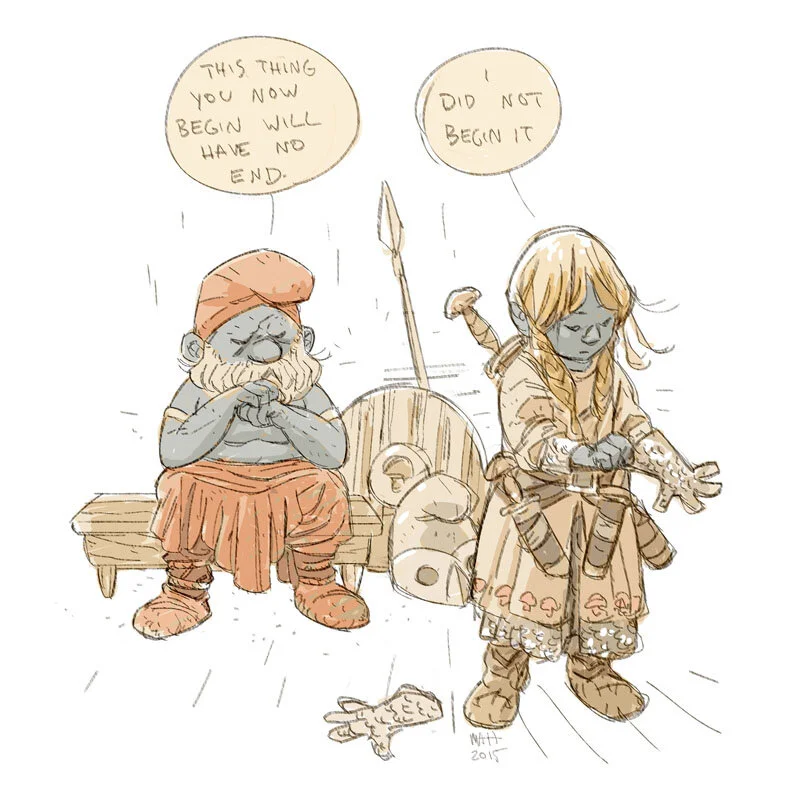
The Second Stone

Illustration by Matt Smith

I like this picture on a couple of levels. One is just the simple idea that Smurfette as a Viking shieldmaiden is pretty awesome. If this were the basis for a new Smurfs cartoon, I'd watch it.

But more seriously, Smurfette's statement "I did not begin it," resonates with me, because it's such a common viewpoint. She ignores Papa Smurf's warning, and can be seen as having decided that he doesn't know what he's talking about. She's not starting anything. The first stone is not hers.

Papa Smurf's words make it fairly clear that he wouldn't hold inaction against her. This is not a situation in which Smurfette is being pushed into a fight that she'd rather not engage in. While it's unstated what the other Smurfs think of the situation, if Papa Smurf speaks of the community, then Smurfette is acting on her own need to act; the pride at stake is her own.

And I think that this is common. Here, Smurfette stands in for a person wants to see themselves as simply being responsive to something that has happened to them, rather than making something happen. There is a certain comfort, I think, in being reactive as opposed to proactive. And this is why the events that Smurfette is setting in motion will, as Papa Smurf understands it, will have no end. Smurfette's opponent will also see themselves as not having thrown the first stone, and the cycle of retaliation and payback will roll on, because both sides will find themselves in a position where letting the conflict die will feel like weakness. Which also means that for both sides, taking the responsibility for starting the conflict will feel like weakness. And I suspect that many of the supposedly intractable conflicts of the modern world operate this way.

Tuesday, February 25, 2020

Make the Oscars American Again

As I'm fairly sure that you're aware, President Trump has been reported to have been unimpressed that Parasite won the Academy Award for Best Picture. The North American distribution house for the movie, Neon, hit back on Twitter that it was "Understandable" that the President didn't like the movie. "He can't read," they snarked.

I suspect that they missed the point. President Trump's alleged desire to always be the center of attention has been well remarked-upon by the news media since the 2016 primary campaign season. One would think that in the intervening four years, they would have come to the realization that some of the President's statements can be chalked up to that desire for attention. Of course, this does leave them in something of a quandary. After all, someone will dutifully report on anything that the President has to say, no matter how pointless, and the "What Has Trump Done Now" constituency will rush over to read it. Being left off the bandwagon in bad for clicks, and thus, advertising revenue, so nothing must be left to lie as unimportant.

But it's also just as plausible that the President really didn't care one way or another about the Academy Awards. His comments were made during a reelection campaign rally in Colorado Springs. This places the President in front of an audience that has been very receptive to his "America is the best" rhetoric, and the case can be made that his calling for more movies like Gone With the Wind and Sunset Boulevard to be made and, presumably, to win Best Picture, is simply pandering to an audience that believes that even if the United States isn't best at literally everything, that institutions that reside in the United States should always favor domestic productions above all others. And drawing attention to a disagreement (real or fabricated) with the Academy of Motion Picture Arts and Sciences for their lack of patriotism plays well in "the Heartland," especially for those whose understanding of "patriotism" goes beyond "my country, right or wrong" to "my country is always right."

Partisanship often expresses itself in an understanding that the world is withholding from one what they truly deserve. And eventually, that deserving stops becoming due to having earned something in a way that can be objectively demonstrated. Rather, it becomes an assumed entitlement; the deserving becomes the proof of having earned it. Talking about these entitlements doesn't always have to be particularly dramatic, or bellicose. Sometimes, simply reminding people that the things they like aren't well enough appreciated by the people they don't like is enough.

Monday, January 13, 2020

Change of Venue

It's movie awards season, with the 92nd Academy Awards coming up in the beginning of February. And now that nominations have been released, there has been something of a teapot tempest over the lack of women nominated for Best Director. The director of Little Women, Amy Pascal, suggested that part of the reason may be that most (some 72%) of the voting members of the Academy of Motion Picture Arts and Sciences are men, and they are voting for the movie that appeal to them, personally. People are, she says, voting for the movies, the stories, that are important to them, rather than out of any deliberate bias. The BBC asks if the demographics of the people who give the awards has an impact on the stories they prefer, and thus the people who receive the awards.

All the movies nominated this year are good, and I can’t believe Bafta voters are inherently racist and misogynist, but the telling thing with lists is that they without doubt reflect the personality of the person or people compiling them.
Jason Solomons, Movie critic and journalist.
Georgie Yukiko Donovan notes that awards are something of a stamp of approval, one that allows moviemakers to move up the career ladder. But she also feels that the money needed to successfully campaign for an award means that "gender, race, money and class" are important factors. Critic Melissa Silverstein feels that the generally older White male perspective of the majority of awards judges invalidates the experiences of people outside of that demographic, and when all of the nominations for an award reflect that, then the award should not be given.

But maybe there's a better option. If the Academy Awards are too important to a filmmaker's career to be left to the whims of the voting members of the Academy of Motion Picture Arts and Sciences, then the Oscars should be replaced with an award that better reflects the population that's important to the film industry. While the Oscars, and other major awards, are important because the press pays attention to them, they're also important because filmmakers compete for them. The time, effort and money that go into campaigning for the Oscars are representative of the prestige that they bring, but they also contribute to that same prestige.

Since awards season concentrates on movies that have already been released, there is a certain amount of sway that a new award can have. I don't know anyone who goes to a movie and then declines to make up their mind as to whether or not they enjoyed it until they find out how many Oscar nominations it received. The public can have very vocal opinions as to what they like or dislike in cinema, and are more than capable to disputing the choices that awards bodies make. So why not look to an award that selects a slate of candidates that matches the demographics one prefers and compete for that award? Sure, it will take some time to shift the public's attention to the new award. But change always takes time. And I suspect that it would be simpler than either expecting Academy or BAFTA or what-have-you voters to leave their own likes and dislikes at the door, or making wholesale changes to their voting memberships.

It's true that Oscars mean a lot to people, and a new award won't mean as much. But that focus on this particular award creates a neediness that threatens to eventually undermine it. If people understand that there is some sort of diversity quota built into the awards, will they retain the faith that the movies selected have earned their positions on the merits, or come to believe because someone else has determined the winners in advance, they awards are somewhat fraudulent. And if the current awards electors are simply middlemen, why not dispense with them?

Tuesday, May 21, 2019

Chronicles of Banality

Nobody in Particular is banal. I, as its author, understand this. I'm not a particularly insightful or artistic person, and so there's not much here for the person who's really looking for a different take on the world. And in that sense, I wonder if it will ever really be useful beyond the exercise in writing and/or discipline that it provides me.

I don't know that it will be, but I would like to think that it will have some use to someone at some point in the future. History is made by great people, art is made by creative people and so on, but perhaps the day-to-day understandings (or misunderstandings) history and artistry will provide a context for people to make sense of them.

For nearly all of the events of the present, and every event of the past, I only have second-hand knowledge. I was not present to see them myself. (For instance, I didn't go out for lunch today, and so missed the abortion-rights protest that was taking place across the street from the building I was in.) The only way I can know anything about these events is to receive information from some other party. Who may or may not actually have been present themselves. And so much of what I know about the world is due to someone deciding that it is important enough to tell me. But the important things that happen when I am present for them are few and far between.

And so I write about things that are everyday and humdrum, and I'm likely an everyday and humdrum writer. Hopefully, that is okay.

Thursday, July 13, 2017

Not Even Past

I'm going to indulge in my habit of liberal quoting again for a moment, because I'd like to give the entirety of the criticisms leveled about old comics. I'm not reprinting the whole of the descriptions of them, but pulling out the sentences that concern us here.

1905: Little Nemo in Slumberland
Shame about that Jungle Imp character, though, who serves as a cold reminder that blithely racist stereotyping has been a part of the visual language of the comics medium since its inception.

1929: Tintin
And racially iffy.

(Hot tip: Skip Tintin in the Congo. Trust us.)

1934: Terry and the Pirates
Milton Caniff's two-fisted action adventure strip about a boy named Terry, his frequently stripped-to-the-waist mentor Pat, and — regretfully enough — a Chinese man name Connie who speaks, well, pretty much like you'd imagine a Chinese character would speak in an American-made comic strip from the 30s and 40s. More's the pity.
The Old School: Classic Strips That Continue To Shape Comics
In the ongoing debate over absolute versus relative values, the stereotype is often that the Right are absolutists, believing that their understanding of right are wrong are objective facts of live not subject to a person's lived experience, and that the Left are relativists, believing that different people can come to differing but equally valid understanding of ethics and morality. But the Left does have its own version of moral absolutism, and that is that advanced Western societies should always have espoused values that line up with modern understandings of race, class and gender issues.

Note that the knocks on Little Nemo in Slumberland, Tintin and Terry and the Pirates are not for being out of step with the times in which they were written. It's that they're not in line with the values of 80 to 100+ years after they were written. And implicit in that is a wager that, come 2100 to 2130, people will see the world of 2017 as being thoroughly modern and in line with their contemporary values. But it's just as, if not more likely, that people (especially the 15 to 35 set) in that time will find barbarism and backwardness in something that we don't think of as particularly wrong. We could hope that the early 22nd century sees the end of judgmentalism, but that seems like a long shot, at best.

Instead, I suspect that they will judge us, and our works, by their contemporary values, and regard them as somewhat shameful, iffy, regretful and worthless, even as they see them as valuable for their staying power and historical context. Of course, in that I'm making a wager myself, and on flimsy evidence at best - namely that over the next 80 or so years of human existence, societies won't decide that judging the past by the standards of the present is simply an exercise in self-righteousness. After all, the fact that "it's always been done that way" doesn't mean that it always will. Still I'd like to see us to a better job of understanding that values evolve, not because human history is a steady progression from Bad to Better, but because of people doing what works for them in the contexts in which they find themselves, and those contexts change over time. The best way to ensure that the future breaks with the habit of looking down its nose at the past, is to break with it ourselves.

Wednesday, January 11, 2017

The Amored Warrior

When I was in high school, Robotech came out on television. For those of you unfamiliar with it, Robotech was a show cobbled together out of three Japanese animated science-fiction shows: Super-Dimension Fortress Macross, Super-Dimension Cavalry Southern Cross and Genesis Climber Mospeada. In their native Japanese, the three shows were completely unrelated, and while the writing staff as Harmony Gold managed to alter their plotlines and backstories fairly competently and create a fairly workable meta-plot that wove the three together, there were still enough plot holes make the whole thing resemble Swiss cheese. But I was in high school - what did I care? In any event, my linking up with other fans of the show introduced me into a rather remarkable world of "Giant Robot" anime. That world turned out to have two primary branches. And at the base of one of them, the same one from which the shows that became Robotech grew out of, was Mobile Suit Gundam.

American cartoons, like G. I. Joe or Transformers were basically brawl-of-the-week-club. The "bad guys" would come up with some sort of scheme or plot, and attempt to put it into action. The "good guys" would sorté out to stop them, a battle would ensue and the bad guys would lose, returning the world a a whole to the status quo, after which a short Public Service Announcement would run. What set Gundam, and many other Japanese shows (imported the the United States or not) apart from this, was that there was a continuing storyline, and while the giant-robot throwdown was important, it wasn't the whole story.

Despite being just as much a 30-minute toy commercial as Transformers was, Gundam was also a drama, and one with a remarkably compelling story at its heart. The basic gist was this: In the 21st Century, mankind was united under the auspices of the Earth Federation; basically the United Nations. The national boundaries that had defined nation-states were gone. Earth was overcrowded, at least as far as the leaders of the Federation were concerned, and so they embarked upon an ambition program to colonize space in the immediate neighborhood of the Earth and the Moon. By mining the Moon and every asteroid they could catch for resources, the Earth Federation managed to construct hundreds of large O'Neill cylinder-style space stations (which the animation staff for Gundam simply copied more or less verbatim from the original designs), and clustered them into large groups called "Sides" at various LaGrange points in the Earth-Moon area. Then they began sending people to them. In a lot of science-fiction, it's the wealthy people who move to space. In Gundam, it was poorer people who were sent to be space colonists. Which makes a certain amount of sense. Space stations are relatively fragile. One errant asteroid or out-of-control cargo vessel can ruin your whole day.

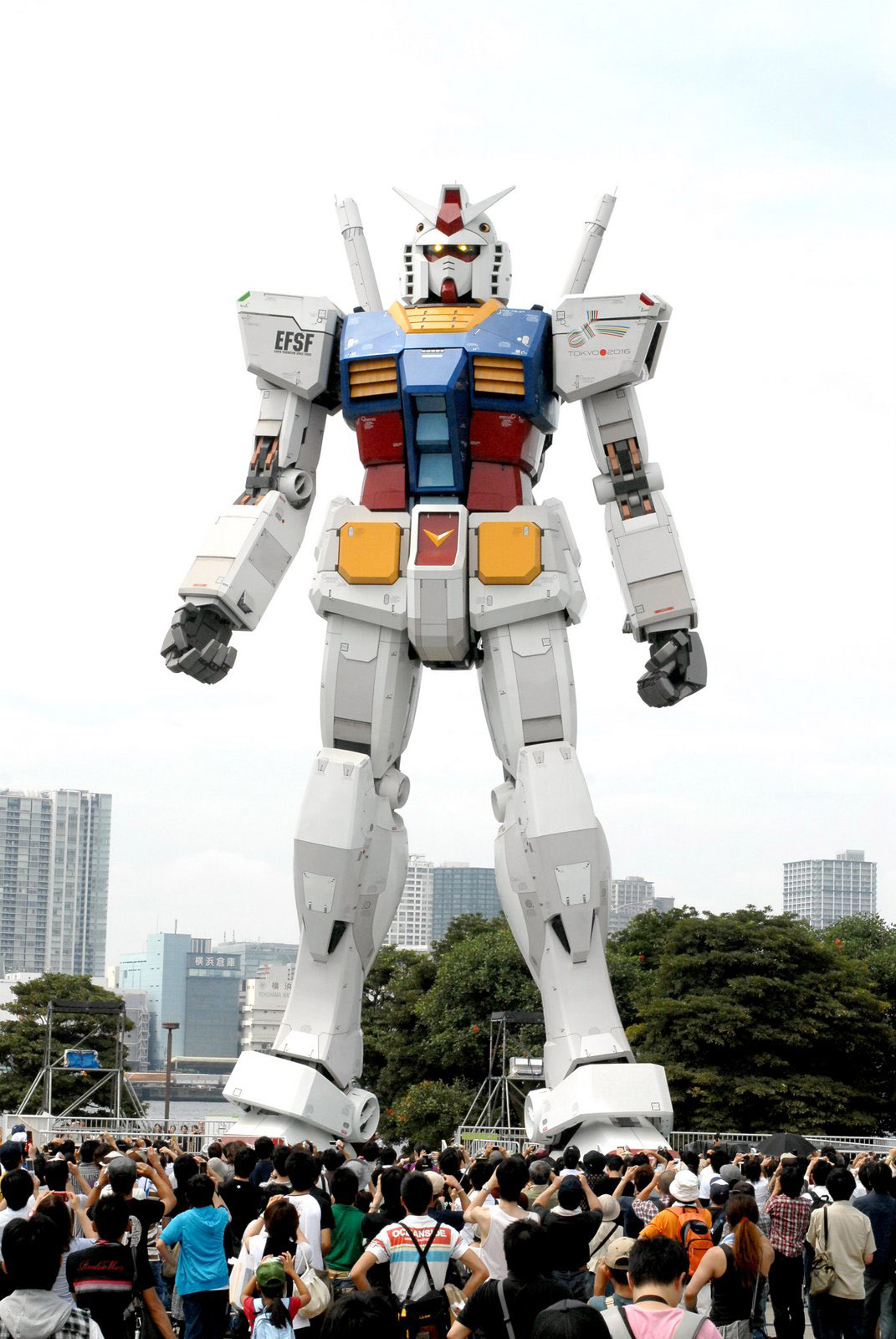
Space colonies, like other types of colonies, have a habit of wanting to be independent, and that drive for independence eventually broke out into a shooting war. With giant robots. But it's not as silly as it might sound. Gundam pioneered what is now referred to as the "Real Robot" genre in animé. While the show doesn't always reflect them, the Mobile Suits that various characters piloted had descriptions and statistics that were meant to give you an idea of how these things fit into the real world. The RX-78-2 Gundam has a set height. Which is how they were able to build a "life-size" model of the thing and put it on display:

Big, isn't it? (Photo by Yoshiaki Miura in The Japan Times)
It has a defined (if not exactly realistic) weight, the machine-guns mounted in it's head are 60mm caliber, et cetera. This isn't to say that it's hard science-fiction, far from it. But it's defined in real-world terms.

In the end, Mobile Suit Gundam is a coming-of-age-story set against the backdrop of a civil war that rages through space and various places on the Earth and Moon. One where giant robot war machines fill in for tanks, space fighters, helicopters and any other of a number of more mundane types of military hardware, yet without completely displacing them. And it's one of my longest-lasting hobbies. From time to time, rather than grouse about current events or pontificate on things, I'll talk about this instead. Not from the point of view of an expert, but rather as a long-time fan. It should make for a nice change of pace.

Tuesday, May 10, 2016

Switcheroo

It’s a stereotype of the Republican party that they are intensely focused on “personal responsibility.” Which tends to be accurate, until identity politics enters the picture; at which point the stereotype changes, and Republicans feel that all members of any aggrieved group become their brother’s keepers, and the problem becomes one of group behavior. Such is the case with this Michael Ramirez cartoon from a while back, which makes the case (accurately) that a young Black man is more likely to be shot by another young Black man than they are by a White police officer. But this is true of any group. White criminals are much more dangerous to the White community than Black police officers are. But, since White Americans lack a reputation for criminality (at least in the eyes of conservative commentators and cartoonists), and there hasn't been a spate of shootings at the hands of Black police officers, there is no pressure on them to reform their entire community as a means of pushing back against complaints about police misconduct or simply overzealousness.

Friday, February 5, 2016

Craftsmanship

I spend a lot of time writing about the things that people do that leave me scratching my head or get on my nerves, despite not wanting my blogging to be simply me complaining about things. So today I'm showing off some miniature painting work done by an acquaintance of mine. Enjoy.

Isn't it amazing what you can do with something only a couple of inches tall?

Friday, November 6, 2015

Fashionably Crazy

From the Counter Couture exhibit at the Bellevue Art Museum. A lot of the clothing that was displayed must have taken a lot of effort. I found myself wondering what today's fashions would be like if the wealthy and powerful of the 1960s had adopted clothing like this, which, in a lot of ways mirrors the sort of fashion that had attracted the upper classes - intricate (and thus likely very expensive), impractical for anything resembling work and difficult to keep clean.

Tuesday, March 17, 2015

The Honest Therapist

It's not as bad as it looks.
Despite one of the common social messages around pairing and relationships, finding a partner is not generally as simple as encountering and choosing to spend the rest of your life with them and having beautiful babies together. Partnering with another person is a mutual choice, so in addition to choosing, one also has to be chosen. And, especially in an area where there are a lot of people around, going unchosen for a long enough time can leave one with the feeling that they are unchooseable in that they lack more or less, all of the qualities that people are looking for. Feeling undesirable eventually comes to feel like an objective state that a neutral observer would confirm, if they were being frank.

This often leads to a certain level of discomfort in others, as while many people understand that beauty is in the eye of the beholder, and that it's not for an individual to dictate to others how they will be seen, there is also a general expectation that everyone will see themselves, at least, as beautiful and possessed of an attractive personality. And so it's easy for us to see pathology in people who publicly acknowledge a mental picture of themselves as undesirable - hence an anonymous poster referring to Connie Sun's cartoon as "self-hating." But it's possible to have a feeling of something yet understand that it doesn't accurately reflect one's reality - even if acknowledging it is somewhat cathartic.

Friday, January 9, 2015

On Satire

There is a thought-provoking piece in The Guardian by Joe Sacco. It is intended to push us into understanding our relationship to satire - and the deliberate giving of offense. So I worked to understand.

The first thing that I understood is that satire is not an objective term. An examination by a physicist will not inform you of whether something is satirical or not. Like offensive, it is in the eye of the beholder. Then I understood that Mr. Sacco had made some very interesting points. So I decided that I would speak to them.

Copied from The Guardian's website, so that you may see what it is to which I am referring.
Though tweaking the noses of Muslims might be as permissible as it is now perceived to be dangerous, it has never struck me as anything other than a vapid way to use the pen.
It strikes me as vapid, too. And? What difference does that make? What I find to be vapid and others find to be gravely offensive still others find to be clever. It is not my place to judge. I must defend the vapid along with the wise. I am stuck defending those (and given that this is the United States, there are a fair number of them) who would use their freedom of speech to denigrate me - and some who would hope to inspire others to be their cat's paws for violence against me, because as vapid as I find it, it is the nature of the beast. The freedom to use the pen in the ways that strike me as clever, uplifting or useful is not the same as the freedom to use the pen.

Bad ideas are sometimes dangerous. But history has shown us the the power to decide which ideas are good or bad (or, inspiring or vapid) and to back that with force - legitimized or otherwise - is nearly always dangerous. People who have been charged with the protection of others almost always come to find that it is in the best interests of the protected that the interests of the protector come first - especially when the protected have few means of enforcing accountability.
And what is it about Muslims in this time and place that makes them unable to laugh of a mere image?

There is nothing about Moslems, apart from those things that are necessary to be Moslem, that does not exist in any other group. I know many non-Moslems who claim they would resort to murder - not only to avenge themselves against those they feel have wronged them, but to show others the price of wrong action. True, those who act in the name of Abrahamic religions often look forward to an eternity of the gratitude of a bloody-minded (but strangely lazy) deity and this undermines the fear of punishment that restrains others, but in the end, they all have chosen a path for themselves based on what they believe that others owe - either to themselves directly, or to the world around them.

When I learned to laugh off a mere image, it was because I came to the understanding that I am not owed anything. The positive (or neutral) impressions of others towards me are not my birthright. I am not entitled to be ignorant of either the possibility or the reality of others' negative opinions of me, nor am I entitled to preventing the spread of same to those who do not currently share them. This is not to say that the opinions of others do not have consequences for me. They do, and if history is any guide, they can be severe in the extreme. But attempting to control people's speech in the hope that I can expunge consequential thoughts is, and was, a fool's game, regardless of the enthusiasm with which I once played.

In the end, the freedom to offend, regardless of how vapid we may find it in practice, may be the only tool we have with which to end offense. Because offense is not in the intent of the offender, but in the reception of the offended. In spite of this, we may not find it valuable. That is our choice to make, and there is nothing that demands we not make it. However, as the saying goes, there are no solutions, only trade-offs. The question is not if we will pay, but only if we will find what we have purchased worthwhile.

Tuesday, October 21, 2014

You Bastards!

Hatred is an isometric shooter with disturbing atmosphere of mass killing, where player takes the role of a cold blood antagonist, who is full of hatred for humanity. It's a horror, but here YOU are the villain.
www.hatredgame.com
I've found the internet debate around this game to be interesting, in part because there seems to be a thread that this particular exploration of the dark side of humanity will somehow be the single straw that breaks the camel's back.

Ever since I was in junior high school (likely before that even), computer programmers have been making games where the primary activity has been to move an avatar around the screen and shoot computer-generated people. Or mutants or aliens or what-have-you. Brøderbund software even had a game named, literally, "If It Moves, Shoot It!" What makes Hatred a horror game, and the player's avatar a villain isn't the activity - it's the reasoning. It can be argued that in more traditional Shoot'em ups that the computer-generated targets fight back. Sure, but, as an article I once read pointed out, the oppositions in computer games is never really about putting up a fair or intelligent fight - they exist to be "killed" by the player. An acquaintance of mine who works in the video game industry noted that if First-person shooters were anything like real life, your character would likely at some point find himself face down in a pool of his or her own blood with no idea what hit them.

I understand the discomfort at the idea of pretending to be a spree killer as a form of entertainment, although I think that at least some of it is born of the uncharitable assumption that there is a sizable number of people out there for whom it would be unambiguously entertaining. But in the end, all of these sorts of games simply offer different pretend reasons for different flavors of pretend violence. Hatred is no exception.

Saturday, September 27, 2014

Object Lesson

There's a photographer who posts on DeviantArt by the name of Marcus J. Ranum. His work is often simply amazing. Back in 2010, he took a stab at exploring the concept of obscenity. Specifically, what makes something obscene and when does it cross the line from "non-obscene." This was the result.

Do-It-Yourself Deviation. Marcus J. Ranum, 2010. URL: http://mjranum.deviantart.com/art/Do-it-Yourself-Deviation-150768428
Part of the question that Mr. Ranum expects that viewers would have asked themselves is: "A pretty girl... a meat slicer? Bananas, rope, and medical implements? How do they possibly go together?" And he points out that there's nothing inherently... anything about this photograph. Whatever it is to a viewer, banal, artistic or even obscene, it's all in what they bring to it.

I was looking at this the other day, and a thought occurred to me. It's entirely possible to decide that not all of the items in this photograph actually do go together. A least not all at once. After all, it would be fairly difficult for the model to wear all three pairs of shoes, or both uniforms, at once. So perhaps your Do-it-Yourself Deviation would remove one or more of those things. Of course, if you did that, you could just as easily remove the model herself. At which point I realized that this doesn't have to be a photograph of "a pretty girl and a pile of stuff" it could, really, instead be a photograph of a black beret and a pile of stuff.

And if it is, in addition to illustrating something about how we see obscenity, we can also use this to illustrate how we see objectification, as the model becomes simply another thing in this picture - no more or less important than any other thing. The main point that Mr. Ranum was making, that obscenity is all in your mind (or, if you prefer, your polka-dot undies) would be just as valid, not only with any other model in this picture, but without any model at all. The very interchangeability that is central to anything we encounter being "just an object."