American cartoons, like G. I. Joe or Transformers were basically brawl-of-the-week-club. The "bad guys" would come up with some sort of scheme or plot, and attempt to put it into action. The "good guys" would sorté out to stop them, a battle would ensue and the bad guys would lose, returning the world a a whole to the status quo, after which a short Public Service Announcement would run. What set Gundam, and many other Japanese shows (imported the the United States or not) apart from this, was that there was a continuing storyline, and while the giant-robot throwdown was important, it wasn't the whole story.
Despite being just as much a 30-minute toy commercial as Transformers was, Gundam was also a drama, and one with a remarkably compelling story at its heart. The basic gist was this: In the 21st Century, mankind was united under the auspices of the Earth Federation; basically the United Nations. The national boundaries that had defined nation-states were gone. Earth was overcrowded, at least as far as the leaders of the Federation were concerned, and so they embarked upon an ambition program to colonize space in the immediate neighborhood of the Earth and the Moon. By mining the Moon and every asteroid they could catch for resources, the Earth Federation managed to construct hundreds of large O'Neill cylinder-style space stations (which the animation staff for Gundam simply copied more or less verbatim from the original designs), and clustered them into large groups called "Sides" at various LaGrange points in the Earth-Moon area. Then they began sending people to them. In a lot of science-fiction, it's the wealthy people who move to space. In Gundam, it was poorer people who were sent to be space colonists. Which makes a certain amount of sense. Space stations are relatively fragile. One errant asteroid or out-of-control cargo vessel can ruin your whole day.
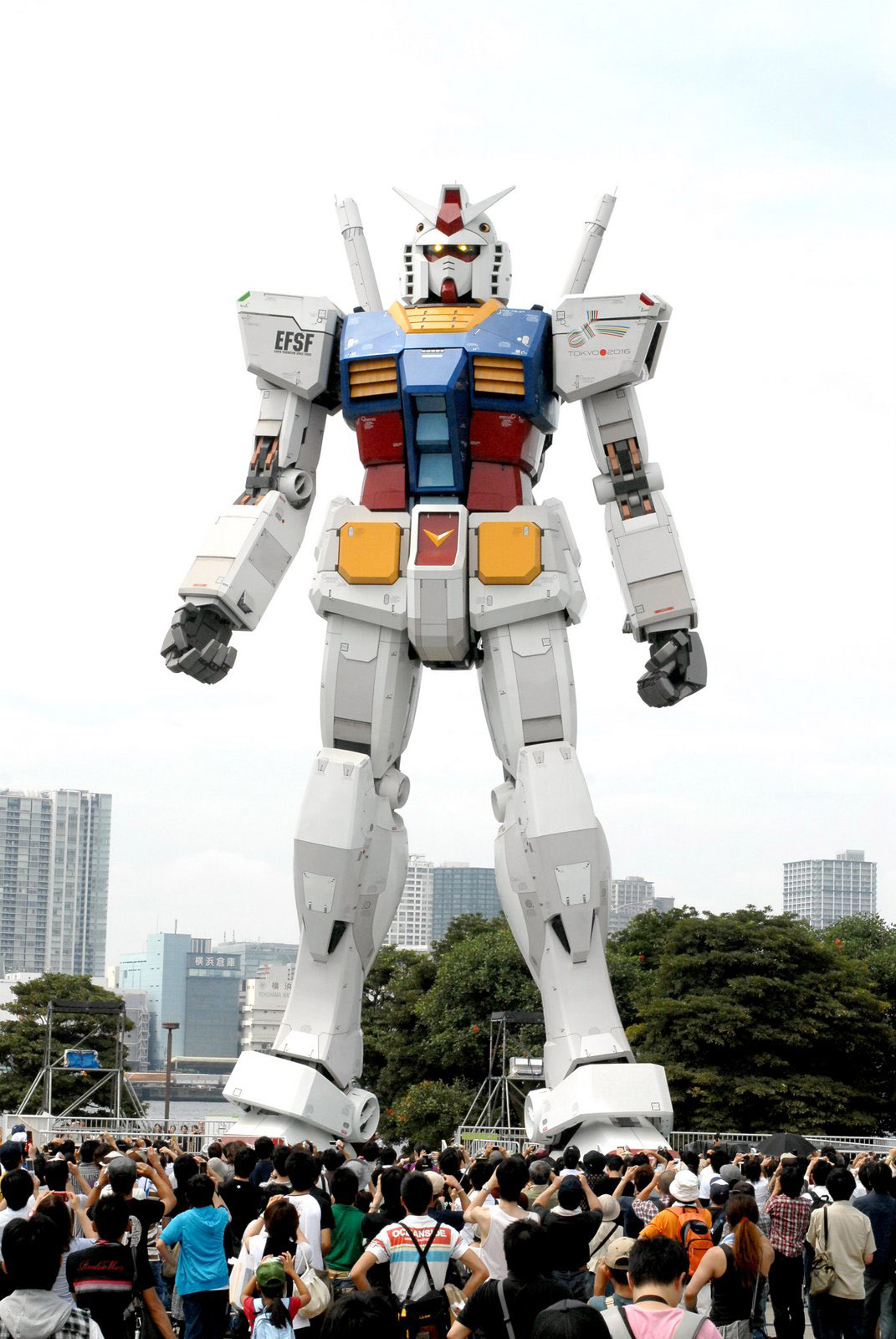
Space colonies, like other types of colonies, have a habit of wanting to be independent, and that drive for independence eventually broke out into a shooting war. With giant robots. But it's not as silly as it might sound. Gundam pioneered what is now referred to as the "Real Robot" genre in animé. While the show doesn't always reflect them, the Mobile Suits that various characters piloted had descriptions and statistics that were meant to give you an idea of how these things fit into the real world. The RX-78-2 Gundam has a set height. Which is how they were able to build a "life-size" model of the thing and put it on display:
 |
| Big, isn't it? (Photo by Yoshiaki Miura in The Japan Times) |
In the end, Mobile Suit Gundam is a coming-of-age-story set against the backdrop of a civil war that rages through space and various places on the Earth and Moon. One where giant robot war machines fill in for tanks, space fighters, helicopters and any other of a number of more mundane types of military hardware, yet without completely displacing them. And it's one of my longest-lasting hobbies. From time to time, rather than grouse about current events or pontificate on things, I'll talk about this instead. Not from the point of view of an expert, but rather as a long-time fan. It should make for a nice change of pace.
No comments:
Post a Comment